
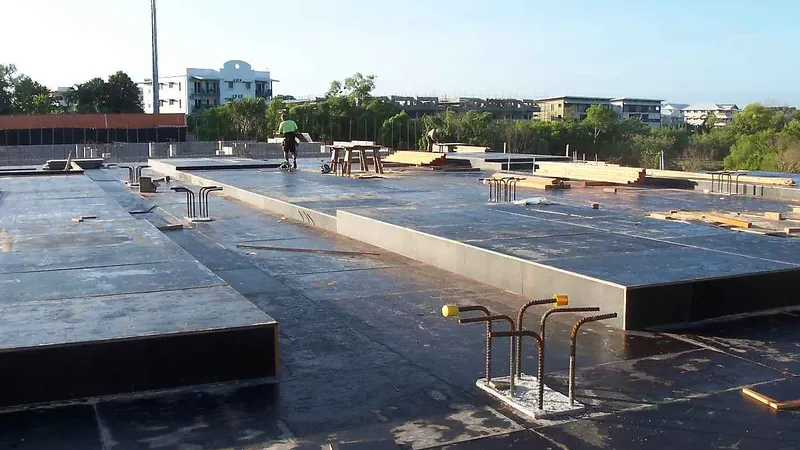
Construction-linked home loans: how banks release the money for an under-construction flat, stage by stage
Your bank pays an under-construction loan in tranches tied to the building's progress, not in one go. The RBI and NHB rules behind that, how a tranche is released, how RERA's 70% project account runs alongside it, and a worked example of how the split between your money and the bank's changes the interest bill.
Rules and rates as of 19 October 2026.
When you take a home loan for a flat that is still being built, the sanction letter shows one big number. The bank does not pay it out in one go. It releases the money in pieces, as the building goes up, and each piece needs paperwork from you, the builder and often the bank's own engineer. This explainer covers how that release works, which rules sit behind it, and what to watch so a slow tranche does not land you with a late-payment bill.
What you pay the bank each month during construction (pre-EMI or full EMI) and builder-funded "subvention" deals are covered in separate explainers. This piece is about the money flowing out of the bank. It is general information; your loan agreement and sanction letter decide the details.
The rule: no money ahead of the building
For banks, the RBI's Master Circular on Housing Finance (RBI/2025-26/16, 1 April 2025) says in paragraph 4(c) that disbursal of housing loans sanctioned to individuals "should be closely linked to the stages of construction", and that "upfront disbursal should not be made in cases of incomplete / under-construction / green field housing projects". The wording dates back to an RBI circular of 3 September 2013, written after schemes in which banks paid builders the whole loan on day one.
Paragraph 4(d) carries one exception: for projects sponsored by government or statutory authorities, banks may follow the authority's own payment stages, provided the authority has no record of failing to complete projects.
For housing finance companies, the National Housing Bank wrote to all registered HFCs on 20 November 2025 (MRO/DOS/DOC/2025/04924). It said disbursement must be "strictly linked to the stages of construction", with no upfront release for incomplete, under-construction or greenfield projects. It points HFCs to paragraphs 87 to 89 of the RBI's 2021 Master Direction for HFCs.
The RBI has since issued consolidated Commercial Banks (Credit Risk Management) Directions, 2025, updated on 1 October 2026. We could not open their text, so we have not confirmed whether the stage-linking paragraph moved there unchanged.
How a tranche actually gets released
Lenders run their own processes, but the steps usually look like this.
- Your own contribution goes in. A bank cannot fund the whole price. Paragraph 3(b) of the same Master Circular also says stamp duty, registration and other documentation charges are not to be counted in the property's cost for loan-to-value purposes, except where the house costs ₹10 lakh or less. So stamp duty usually comes from your pocket.
- The builder raises a demand letter when a stage in your agreement is reached: plinth, a slab, brickwork and so on.
- Supporting proof. Many lenders ask for an architect's or engineer's stage certificate and may send their own technical valuer to the site. This is lender practice rather than an RBI requirement spelled out in the circular.
- You sign a disbursement request, with the demand letter and receipts for your own share.
- The bank pays the builder directly, usually into the account named in the demand, and your interest clock on that tranche starts.
Where RERA fits: the builder's side of the same money
The Real Estate (Regulation and Development) Act, 2016 adds a parallel check on the builder. Section 4(2)(l)(D) requires that 70% of the amounts realised from allottees be kept in a separate account in a scheduled bank, used only for the cost of construction and land. The promoter may withdraw from it only "in proportion to the percentage of completion of the project", and only after an engineer, an architect and a chartered accountant in practice certify that. The accounts must be audited every year.
So construction-linked payment shows up twice: your bank pays as stages are reached, and the builder can draw down the project account only as the work is certified. Neither guarantees the building will be finished on time, but together they limit how far the money can run ahead of the concrete.
Two other RERA provisions matter. Section 13(1) bars a promoter from taking more than 10% of the cost before a written, registered agreement for sale. And section 19(6) and 19(7) make you responsible for paying on time as the agreement specifies, with interest at the prescribed rate on any delay. If your bank sits on a demand for weeks, the builder can charge you that interest.
Worked example: who pays which stage
Illustrative figures. A flat with an agreement value of ₹1,00,00,000, a loan sanctioned at ₹75,00,000 (75%), and your own contribution of ₹25,00,000. The agreement's payment plan has nine stages over 36 months. The bank charges an illustrative 8% a year (repo at 5.50% plus a 2.50% spread; your rate will differ), and interest runs only on what has been disbursed.
Lenders split each demand in one of two ways, set by their own policy and your sanction letter. Own contribution first: you pay demands until your ₹25 lakh is used up, then the bank pays the rest. Pro rata: the bank pays 75% of every demand and you pay 25%.
| Stage (month) | Demand | Bank pays: own contribution first | Bank pays: pro rata |
|---|---|---|---|
| Agreement (0) | ₹10,00,000 | ₹0 | ₹7,50,000 |
| Plinth (4) | ₹15,00,000 | ₹0 | ₹11,25,000 |
| Slabs 1 to 4 (8, 12, 16, 20), each | ₹10,00,000 | ₹10,00,000 | ₹7,50,000 |
| Walls and plaster (26) | ₹15,00,000 | ₹15,00,000 | ₹11,25,000 |
| Services and finishing (32) | ₹10,00,000 | ₹10,00,000 | ₹7,50,000 |
| Possession (36) | ₹10,00,000 | ₹10,00,000 | ₹7,50,000 |
| Total disbursed | ₹1,00,00,000 | ₹75,00,000 | ₹75,00,000 |
| Interest during the 36 months | ₹7,13,333 | ₹9,55,000 |
Formula: interest for each period = amount disbursed so far × 8% ÷ 12 × months until the next tranche, added up across the stages. For example, under pro rata, the ₹18,75,000 out after the plinth stage costs ₹18,75,000 × 0.08 ÷ 12 × 4 = ₹50,000 before slab 1 arrives. Our own month-by-month calculation, rounded to the rupee.
Own-contribution-first costs about ₹2,41,667 less in interest during construction, because the bank's money goes out later. The trade-off is that your ₹25 lakh is committed up front, which is a real cost if that money would otherwise earn interest or if the project stalls early. Ask your lender which method it uses before you sign, and whether it can be changed.
What slows a tranche down
- A demand letter that runs ahead of the stage the bank's valuer sees on site.
- The builder's project not being approved by your lender, or the builder not disclosing the bank to which the project is mortgaged. The Master Circular's paragraph 7 says funds should not be released until a builder's disclosure requirements are met.
- A missing receipt for your own share, or an agreement that is not registered.
- A gap between the stages in your agreement and the stages your bank recognises. Compare the two lists early.
Your checklist before the first tranche
- Get the payment schedule from your registered agreement and match it with the lender's disbursement policy.
- Look up the project's progress updates on your state RERA portal; it should broadly match the demands you receive.
- Keep every demand letter, stage certificate, bank disbursement advice and builder receipt in one file. You will need them for tax, for any dispute, and when the loan is closed.
- If anything in the loan or builder paperwork looks wrong, a lawyer or a chartered accountant can review it before money moves.
What this means for you
If you have a sanction letter for an under-construction flat, ask your lender this week, in writing, whether it disburses own-contribution-first or pro rata, which documents it needs for each tranche (demand letter, architect's certificate, site visit), and how many working days a release usually takes. Put the payment schedule from your registered agreement next to the bank's list of stages and note any mismatch. Then check the project's latest progress update on your state's RERA website, so you can spot a demand that runs ahead of the work before you sign the disbursement request. Since section 19(7) of RERA lets the builder charge interest on late payment, raise any delay with the bank as soon as a demand arrives.
Sources
- RBI: Master Circular – Housing Finance, RBI/2025-26/16, DOR.CRE.REC.No.12/08.12.001/2025-26, 1 April 2025 (paras 3(b), 3(c), 4(a), 4(c), 4(d), 7)primary
- Real Estate (Regulation and Development) Act, 2016, sections 4(2)(l)(D), 13(1), 19(6) and 19(7), India Codeprimary
- National Housing Bank: Disbursement of housing loan linked to stages of construction, MRO/DOS/DOC/2025/04924, 20 November 2025primary
- RBI circular RBI/2013-14/217, DBOD.BP.BC.No.51/08.12.015/2013-14, Upfront disbursal of housing loans, 3 September 2013primary
- RBI: Commercial Banks – Credit Risk Management Directions, 2025 (updated as on 1 October 2026), index pageprimary



