
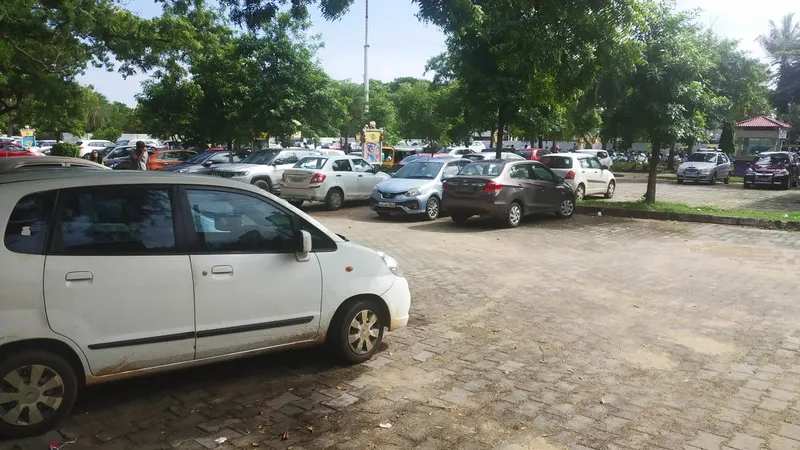
Parking in a new project: open, stilt and covered, what a builder can and can't sell
What RERA's definitions of common areas and garage say, what the Supreme Court held about stilt parking in Nahalchand Laloochand (2010), where Maharashtra's "covered parking" rules leave a grey area, and how to read a ₹5 lakh parking line on a ₹95 lakh cost sheet.
Rules and rates as of 14 October 2026.
Many price sheets for a new flat carry a separate line for parking. Whether a builder can charge that line depends on what kind of space it is. The law treats an open slot in the compound, a slot under the building's stilts and a garage with walls very differently, and the Supreme Court has already ruled on one of them.
What the RERA Act says
The Real Estate (Regulation and Development) Act, 2016 never uses the words "stilt parking" or "covered parking". It does two things that matter.
- Open parking is a common area. Section 2(n), which defines "common areas", lists in clause (iii) "the common basements, terraces, parks, play areas, open parking areas and common storage spaces". Common areas are not sold flat by flat. Under section 17(1), the promoter has to transfer "the undivided proportionate title in the common areas" to the association of allottees.
- A garage is something else. Section 2(y) defines a "garage" as a place within a project "having a roof and walls on three sides for parking any vehicle", and says it "does not include an unenclosed or uncovered parking space such as open parking areas".
The Act clearly expects garages to be sold. Section 4(2)(i) requires the promoter's registration application to state "the number and areas of garage for sale in the project", and section 11(1)(c) requires the promoter to keep updating, every quarter, the number of garages booked on the RERA website. There is no matching provision for selling open parking.
What the Supreme Court decided in 2010
Before RERA, the leading case was Nahalchand Laloochand Pvt Ltd v. Panchali Co-operative Housing Society Ltd, decided by Justices R.M. Lodha and A.K. Patnaik on 31 August 2010 (Civil Appeal No. 2544 of 2010, reported as (2010) 9 SCC 536). The promoter of a building in Dahisar (East), Mumbai claimed 25 stilt parking spaces as its own, relying on undertakings it had taken from flat buyers, and sued the housing society to keep them. The case turned on the Maharashtra Ownership Flats Act, 1963 (MOFA). The court also agreed that those undertakings bound neither the buyers nor the society.
The court held:
- A stand-alone garage is not a "flat" under MOFA. The word "garage" in the definition of a flat covers a garage only "as appurtenant or attachment to a flat".
- Not every parking space is a garage. A garage needs a roof and walls on three sides. An open-to-sky parking area, or a stilted portion used for parking, is not a garage.
- Stilt parking is part of the building's "common areas and facilities". Being neither a flat nor a garage, it "is not sellable at all".
- For common areas, "the only right that the promoter has, is to charge the cost thereof in proportion to the carpet area of the flat from each flat purchaser".
- The entire land and building has to be conveyed to the society, and the promoter's remaining right is to sell unsold flats.
The judgment interprets MOFA, a Maharashtra law. But its roof-and-three-walls test for a garage is almost word for word what Parliament later put into section 2(y) of RERA, and RERA lists open parking as a common area. That is why buyers in other states also cite it.
Where the rules get less clear: "covered parking"
Here the sources do not line up neatly. Maharashtra's RERA rules of 2017 (Housing Department notification REA 2016/CR No.79/DVP-2, 20 April 2017) define a "covered parking space" in rule 2(1)(j) as an enclosed or covered area approved by the planning authority, including basements, stilts, podiums and mechanised parking, but not a garage or open parking. The same rules require the promoter to disclose the number of covered parking spaces, and the registration form asks for the number and areas of garages for sale, including garages at basement, stilt or podium level. The model agreement for sale annexed to the rules has a recital and a clause for a "garage/covered parking (if applicable)", with a price shown separately from the flat.
So on paper a Maharashtra project can carry a separate parking price, while Nahalchand says a stilt slot that is not a garage cannot be sold at all. How far a 2017 rule or a model agreement can go against a Supreme Court reading of what counts as common area is a legal question this explainer cannot settle. If your agreement charges for a "covered" or "stilt" slot, a property lawyer should look at exactly what the clause and the sanctioned parking plan describe.
Other states follow a similar disclosure pattern. Haryana's RERA rules of 2017, for example, ask the promoter at registration for the number of open and covered parking areas in the project, and the form for completion says flats are to be conveyed "alongwith parking (if applicable)".
Parking type and whether it can be sold
| Parking type | What the law calls it | Can the builder sell it separately? |
|---|---|---|
| Open, in the compound (open to the sky) | Common area, RERA s.2(n)(iii); not a garage, s.2(y) | No. Its cost can be built into the common-area price, shared by carpet area |
| Stilt, under the building, open on the sides | Common area and not a garage, per Nahalchand (2010) | No, per Nahalchand. Maharashtra's 2017 rules call it "covered parking", so check with a lawyer |
| Basement, podium or mechanised slot | "Common basements" are common areas, s.2(n)(iii); Maharashtra rule 2(1)(j) calls these "covered parking" | Unsettled. Depends on the sanctioned plan and state rules; take legal advice |
| Garage: roof and walls on three sides | "Garage", RERA s.2(y) | Yes. The Act expects garages "for sale", s.4(2)(i) |
Worked example: a ₹95 lakh flat with ₹5 lakh "covered parking"
Say your cost sheet shows an all-in price of ₹95,00,000, which includes ₹5,00,000 marked "covered parking". The flat's carpet area is 700 sq ft. These are illustrative figures, not from any real project.
- What the flat itself costs. ₹95,00,000 − ₹5,00,000 = ₹90,00,000. Per sq ft of carpet area: ₹90,00,000 ÷ 700 = about ₹12,857. The all-in rate is ₹95,00,000 ÷ 700 = about ₹13,571.
- Parking's share of the price. ₹5,00,000 ÷ ₹95,00,000 × 100 = about 5.26%.
- If the slot turns out to be a common area. On the Nahalchand reasoning, the builder may recover only the cost of the common area, spread by carpet area. Suppose the stilt parking cost ₹40,00,000 to build and the project has 42,000 sq ft of total carpet area. Your share is 700 ÷ 42,000 = 1.67%, so ₹40,00,000 × 700 ÷ 42,000 = about ₹66,667. That is roughly ₹4,33,333 less than the ₹5 lakh line.
- The advance cap still applies to the total. Under section 13(1), the builder cannot take more than 10% of the cost before a registered agreement for sale: 10% of ₹95,00,000 = ₹9,50,000, parking included.
The point of the arithmetic is not that you are owed ₹4.3 lakh. It is that the label on the line decides which rule applies, and the difference can be large. The builder's actual construction cost for parking is rarely disclosed, so the ₹40 lakh above is an assumption.
What to check before you sign
- The registration page. The state RERA website shows the number of garages for sale and, in many states, open and covered parking counts. If a slot is being priced but the project shows no garages for sale, ask why.
- The sanctioned parking plan. Section 2(zq) of the Act counts the "parking and circulation plan" among sanctioned plans. It tells you whether your slot is open, stilt, basement or an enclosed garage.
- The wording in the agreement. "Garage" with a number and a location means something different from "right to use a covered parking space". Keep a copy of the clause and the receipt for the parking amount separately.
- Undertakings. In Nahalchand the builder relied on undertakings signed by buyers that the stilt slots belonged to it, and lost. A signature on such a form does not change what the law treats as a common area, but keep a copy of anything you are asked to sign.
This explains the law; it is not legal advice. For a specific agreement, a property lawyer is the right person to ask.
What this means for you
If you have a cost sheet or draft agreement with a parking charge, do three things this week. First, open the project's page on your state RERA website and note how many garages it lists for sale and how many open and covered parking spaces it declares. Second, ask the builder in writing for the sanctioned parking plan and which slot, by number and level, the charge is for, and whether it is a garage with a roof and three walls or a stilt, basement or open slot. Third, keep the parking amount on a separate receipt and check that everything you pay before a registered agreement stays within 10% of the total price. If the slot is open or stilt parking and the charge is large, show the clause and the plan to a property lawyer before you sign.
Sources
- Real Estate (Regulation and Development) Act, 2016 (India Code): ss. 2(n), 2(y), 2(zq), 4(2)(i), 11(1)(c), 13(1), 17(1)primary
- Supreme Court of India, Nahalchand Laloochand Pvt Ltd v. Panchali Co-operative Housing Society Ltd, Civil Appeal No. 2544 of 2010, judgment dated 31 August 2010, (2010) 9 SCC 536 (text via Indian Kanoprimary
- Housing Department, Maharashtra: Maharashtra RERA (Registration of real estate projects, ...) Rules, 2017, notification REA 2016/CR No.79/DVP-2, 20 April 2017, rule 2(1)(j), rule 3(2)(f), Form A, Anneprimary
- Town and Country Planning Department, Haryana: Haryana Real Estate (Regulation and Development) Rules, 2017, notification No. MISC-107(A)/ED(R)/196, 28 July 2017, rule 3(1)(c), Form REP-VIprimary